Matched to the tests your district actually gives

See what your child needs to work on. Not just how they scored.

Practice built for CogAT, FastBridge, NWEA MAP and your state’s own tests — and a report that names the mistake behind every missed question, so the week before the test is spent on the right thing.

One email, when the app is available. We store the address and nothing else — no name, no tracking pixel, no list we sell. Ask us at any time and we will delete it. Privacy Policy.

Coming soon to the App Store
Coming soon to Google Play

A parent holds the account. No ads, no tracking, nothing sold — ever.

FastBridge aMath · Grade 5 Q 7/21

A rope is 7.5 meters long. It is cut into pieces that are each 0.25 meters long. How many pieces are there?

  • A   3
  • B   30 Correct
  • C   300
  • D   1.875

What the parent sees

Dividing by a decimal. Choosing 3 means dividing by 2.5 instead of 0.25 — a place-value slip, not a division one.

Practice aligned to

  • CogAT
  • FastBridge
  • NWEA MAP
  • Minnesota MCA-III
  • Texas STAAR
  • Math Masters
  • UMTYMP
  • SAT / ACT

Independent preparation material. NavIsh Prep is not affiliated with or endorsed by any test publisher, school district or state education agency, and is not an official test instrument.

29,000+
practice items banked
every one checked before it is served
50 + DC
states covered
their own standards, where a state publishes them
K–12
every grade served
kindergarten through twelfth
260
learning standards
across twelve subjects

How it works

Three steps, and none of them is a form

  1. Add your child and pick your state

    A first name or nickname and a grade level — that is the whole profile. Choose your state when you pick a test, and we serve the standards it actually uses.

  2. Your child practices

    A focused sitting, sized to finish. Questions adapt as they go: a run of correct answers reaches up a grade, a struggle steps back down, and the header counts what is actually being served.

  3. You get something you can act on

    Not a percentile. A breakdown by skill, the specific misconception behind each wrong answer, and the one thing worth ten minutes tonight. On screen and in print.

What you actually get

The report is the product

Anyone can give a child questions. The part worth paying for is the page you read afterwards — which skill is shaky, what the wrong answers have in common, and the one thing worth ten minutes tonight.

  • Broken down by skill, not collapsed into one number
  • The misconception behind each wrong answer, named in plain words
  • A printable copy to take to a parent–teacher conference
  • An explicit statement of what the score does not mean

Avery · Grade 5

FastBridge aMath · 21 questions · 12 March

Practice report

Overall

On track for Grade 5

14 of 21 correct. Strongest on whole-number operations; weakest on decimal place value.

By skill

  • Multi-digit multiplication 5/5
  • Fraction equivalence 4/5
  • Multi-step word problems 3/5
  • Dividing by a decimal 2/6

Tonight’s 10-minute fix

Dividing by a decimal. Four of the six misses came from dividing by 2.5 instead of 0.25 — a place-value slip rather than a division one. Try a few with money: how many quarters in $7.50?

What this does not mean

This is practice, not a diagnosis and not a prediction. It does not measure ability, and it does not tell you how Avery will do on a real test.

Illustrative report. Figures shown are an example, not a real child.

The actual app

Three screens, straight from the product

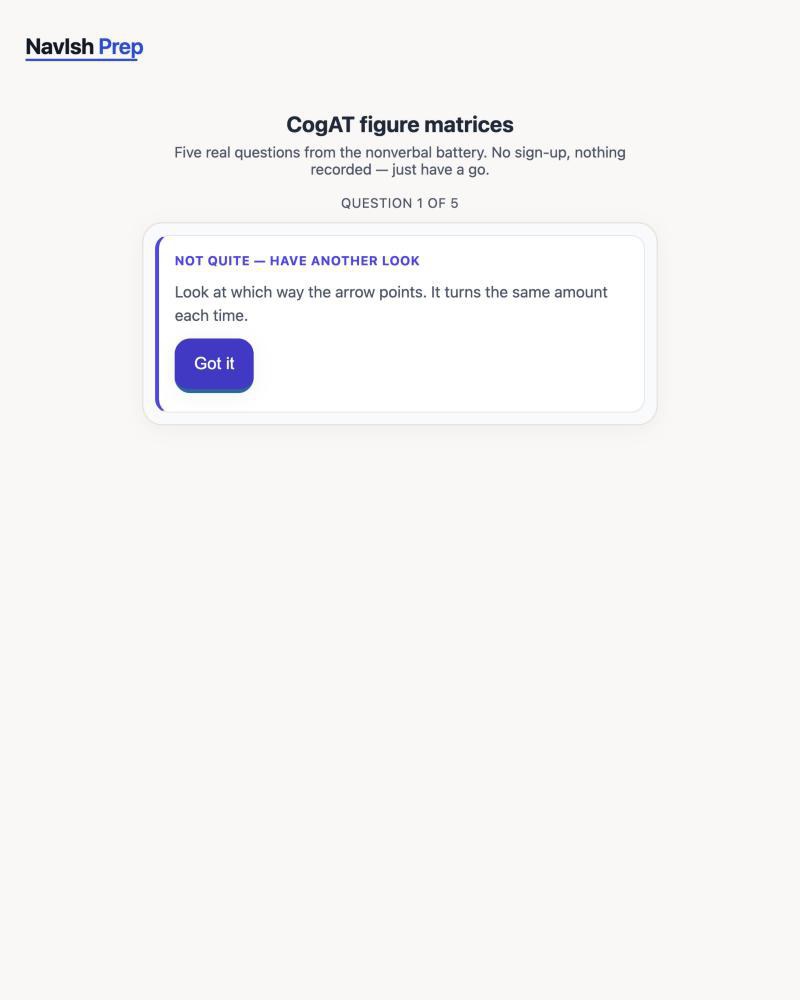
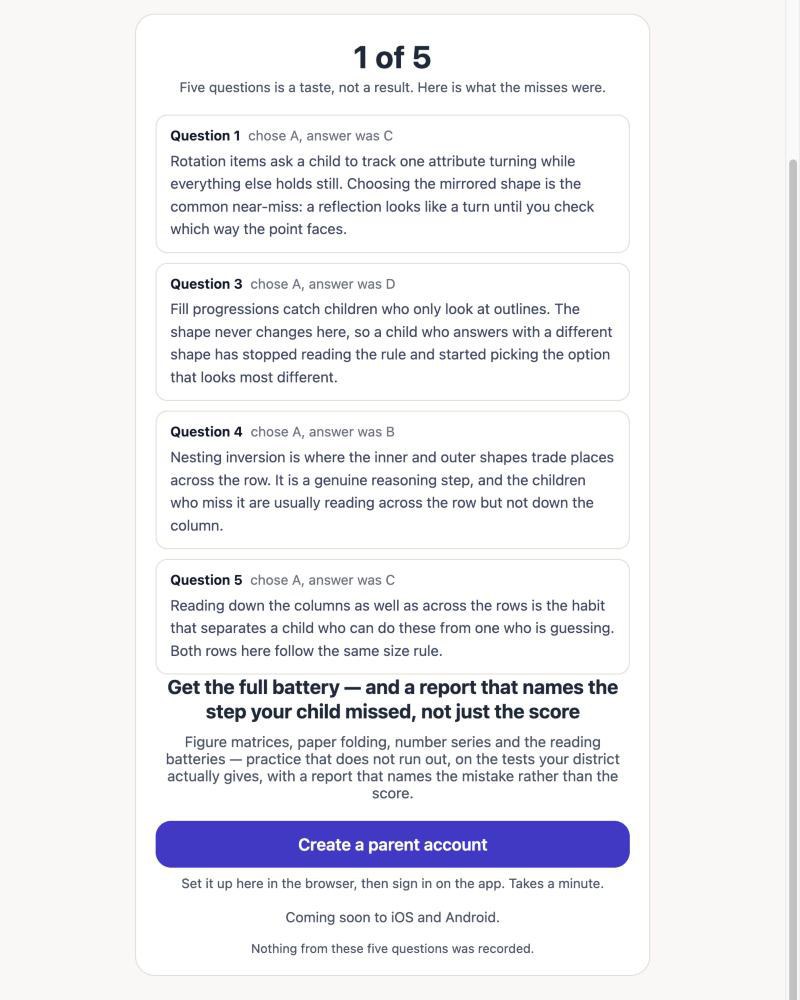
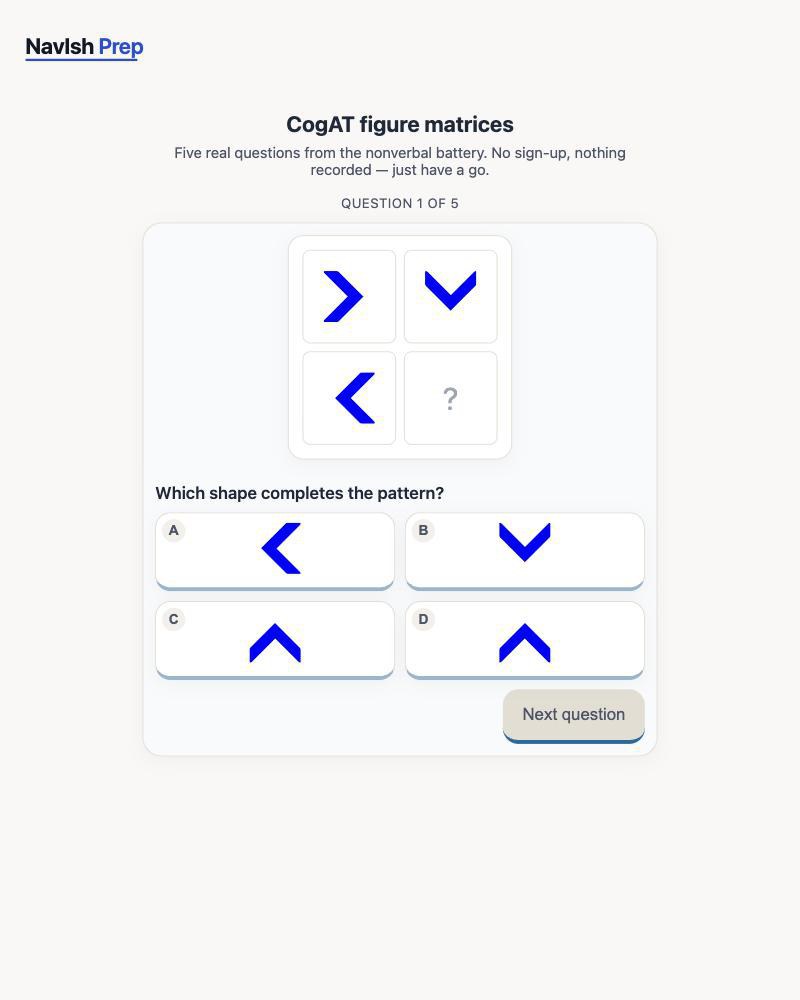
Not mock-ups. These are screenshots taken on an iPad — the device most children will actually use — of the sample you can try right now, without an account: five real CogAT figure matrices.

A CogAT figure matrix question in the NavIsh Prep app, showing a three-by-three grid of blue arrows with one cell missing and four answer choices labeled A to D.
A real figure matrix, drawn by the app rather than scanned from a workbook.
The coaching card shown after a wrong answer, reading: Not quite — have another look. Look at which way the arrow points. It turns the same amount each time.
A wrong answer gets a nudge at the point of the mistake, not a cross.
The end-of-sitting summary listing each missed question, the answer chosen, the correct answer, and a plain-English explanation of the mistake.
At the end, every miss is named — what was chosen, what was right, and why.

What you get

Built for the questions parents actually ask

Three things decide whether practice helps: whether it matches what the school tests, whether it stretches a child who is ahead, and whether it tells you what to do next.

Aligned where you live

State and national standards

Practice matched to the standards your district teaches to, not a generic national average.

  • Minnesota MCA-III, Texas STAAR and the Common Core national set
  • A plain curriculum note whenever practice falls back to the national standard
  • Reading, mathematics, language, science, social studies, computer science

Beyond grade level

Gifted and accelerated tracks

Screeners and enrichment programs get their own item banks rather than a relabeled grade-level question.

  • CogAT Verbal, Quantitative and Nonverbal — each from its own bank
  • Math Masters (grades 4–6) and UMTYMP (grades 5–8)
  • SAT and ACT preparation for grades 9–12

What to do tonight

Actionable parent insights

A score says where a child landed. A report should say what to do next.

  • Every question, your child's answer and the correct one
  • Skill-level breakdown rather than one composite number
  • A clear statement of what a score does not mean

Why this exists

I built this for my own two children first

We are a regular family. Two kids, the usual run of school assessments, gifted screeners and accelerated math programs — FastBridge, NWEA MAP, the state test, CogAT, and the math competitions that come with their own entrance process.

Finding good practice material for those turned out to be harder than it should be. School screeners and accelerated math tracks are not well served, and most of what exists is a static PDF that does not adapt to what a child already knows. A worksheet cannot tell you that your child has the method and keeps losing a place value.

Before building anything, I tried the major models directly — ChatGPT, Claude, Gemini — to make practice questions for my kids. They failed in three consistent ways.
  1. Visual and non-verbal questions did not work

    Ask a chatbot for a CogAT figure matrix, a paper-folding item or a number puzzle and it cannot draw the shapes properly. When it does produce something, more than one answer often works — or the wrong choices just change color instead of testing the spatial rule the item is supposed to be about.

  2. Wrong grade level, and weak answer choices

    Ask for a third-grade reading or math question, or a sixth-grade accelerated math problem, and the model writes something well above grade level, or puts the answer inside the hint, or invents random wrong options. Good wrong answers are the hard part: they have to be the mistakes children actually make — adding instead of multiplying, forgetting to distribute — or the question measures nothing.

  3. No tracking, and nothing for the parent

    Generating one-off questions in a chat window does not adjust difficulty as a child answers, and it gives you nothing at the end — no summary of which skills need work, no record of whether last week's weak spot moved.

So I built one clean place where the questions match the real test formats, the math and the visual grids are checked before a child ever sees them, and the report tells you in plain English what went wrong on a missed question. No ads, and nothing collected about a child beyond a first name and a grade.

— A parent · Founder, NavIsh Prep

Pricing

One price for the whole family

All three plans are the same product — the only difference is how long you commit for, and how much that saves you. Cancel at any time in two taps.

  • Unlimited sittings for every child on the account
  • Every test the catalogue covers, at your child's grade
  • The full parent report after each sitting, printable
  • Progress across weeks, once there are enough sittings to show one
  • No ads, and nothing collected about a child beyond a first name and a grade

Monthly

$12.99 per month

The shortest commitment, and the full price.

Quarterly

$24.99 every 3 months

$8.33 a month

Saves 35% against monthly.

Yearly

$79.99 per year

$6.67 a month

Saves 48% against monthly.

You can’t subscribe yet

The apps are not in the stores yet, and subscriptions are sold inside them. Leave your email and we’ll tell you the day it opens — one email, nothing else.

One email, when the app is available. We store the address and nothing else — no name, no tracking pixel, no list we sell. Ask us at any time and we will delete it. Privacy Policy.

Already have an account? Sign in

Prices in US dollars. Subscriptions are sold and billed by Apple or Google through your store account, and the exact price in your currency is shown on the purchase screen before anything is charged. They renew automatically until canceled; cancel at any time in your store account and access continues to the end of the period you have paid for. See the Terms of Service for the full billing terms.

Privacy first, and enforced

Nothing follows a child anywhere

This is not a policy we wrote and hope to keep. It is a test that fails the build: every request the app makes is checked against a named list of hosts, and any third-party tag, tracker or cookie breaks it before release. This website holds itself to the same rule — it loads no JavaScript and contacts nothing.

No child contact details

A child profile is a first name or nickname and a grade. We never ask a child for a surname, email address, phone number, photograph or location, and there is no free-text field a child can type into.

No trackers, no ads

No analytics, no advertising SDK, no third-party tag, no cookie. The app talks to our own API and to our authentication provider, and to nothing else.

Never sold or shared

We do not sell personal information, and we do not share it for advertising or cross-context behavioral profiling. There is no opt-out to find, because there is nothing to opt out of.

COPPA, and parents in control

A parent or guardian holds the account. Settings, purchases and reports sit behind a parental check, and the whole account and all child data can be deleted from inside the app.

Questions parents ask first

Is this an official practice test?

No, and we will never imply otherwise. NavIsh Prep is independent preparation material aligned to publicly published standards and to the general format of widely used assessments. Our items are written by us — they are not actual, retired or leaked test questions, and we are not affiliated with any test publisher, district or state agency.

What do you collect about my child?

A first name or nickname, a grade level, a profile icon, and what happened during practice. We never ask a child for a surname, an email address, a phone number, a photograph or a location, and there is no free-text field a child can type into. The account is yours, not theirs.

Do you show ads or sell data?

No to both, and there is no asterisk. There is no analytics service, no advertising network, no third-party tag and no cookie — in the app or on this website. An automated test runs against the app and fails the build if any screen contacts a host outside a named list.

Can I cancel easily?

Yes. Subscriptions are managed in your App Store or Google Play account and cancel in two taps; the app links you straight to the screen. You can also delete your account and every child profile from inside the app, with no email or phone call required.

Will this raise my child's test score?

We do not promise that, and you should be skeptical of anyone who does. Practice builds familiarity with a format and shows you which skills are shaky. What you do with that is what matters.

Is the parent report available in Spanish?

Yes — the diagnostic report reads in English or Spanish, switched with one tap, and your choice is remembered on the device. The summary, the skill breakdown and the guidance are translated; the short per-question explanations are still shown in English for now. Your child's practice is unaffected by the setting.

Talk to a person

Questions about an account, a subscription, or a report? Email us and a person will read it.

Support and billing

customer-support@navishprep.com

Account help, subscriptions, cancellations and anything that is not working.

Privacy requests

privacy@navishprep.com

Access, correction and deletion requests. These carry legal deadlines and go to their own inbox.